 Aug 29 2026
 Aug 22 2026
 Aug 15 2026
 Aug 08 2026
 Aug 01 2026
 Jul 25 2026
 Jul 18 2026
 Jul 11 2026
 Jul 04 2026
 Jun 27 2026
 Jun 20 2026
 Jun 13 2026
 Jun 06 2026
 May 30 2026
 May 23 2026
 May 16 2026
 May 09 2026
 May 02 2026
 Apr 25 2026
 Apr 18 2026
 Apr 11 2026
 Apr 04 2026
 Mar 28 2026
 Mar 21 2026
New Scientist covers the latest developments in science and technology that will impact your world. New Scientist employs and commissions the best writers in their fields from all over the world. Our editorial team provide cutting-edge news, award-winning features and reports, written in concise and clear language that puts discoveries and advances in the context of everyday life today and in the future.
The need for speed • We must find a balance between haste and getting mired in medical inertia
New Scientist
A distant visitor puts on a show
The best way to train your brain • A type of cognitive training that tests people’s quick recall has an “astonishing” effect on dementia risk, possibly by boosting brain connectivity, finds Helen Thomson
First settlers in the high Arctic made epic voyage to remote islands
Synchronised eruptions on Io hint at a spongy interior
Lower emissions during lockdown linked to rapid rise in methane
Forever chemical triples due to ozone-preserving refrigerants
‘Altruistic’ bacteria may boost health • High numbers of a mysterious group of gut bacteria appear in healthy people, hinting that targeting these microbes through diet or probiotics could prove helpful, finds Chris Simms
Why exercise doesn’t help weight loss • When we exercise more, our bodies may compensate by using less energy for other things – especially if we eat less too, discovers Michael Le Page
Fast-charging quantum battery shows promise
Antarctic glacier’s worrying speed burst
The toxic burden of pesticides is growing around the world
Psychedelic causes a similar state of mind to meditation
How to master ‘hidden’ friction • Controlling friction caused by electron interactions could make machines more efficient
Nasal spray could prevent infections from any flu strain
Statins don’t cause most of the side effects listed on their labels
You could soon enjoy grapefruit without the bitterness
The secret to living a meaningful life
Quantum simulator may unlock new materials
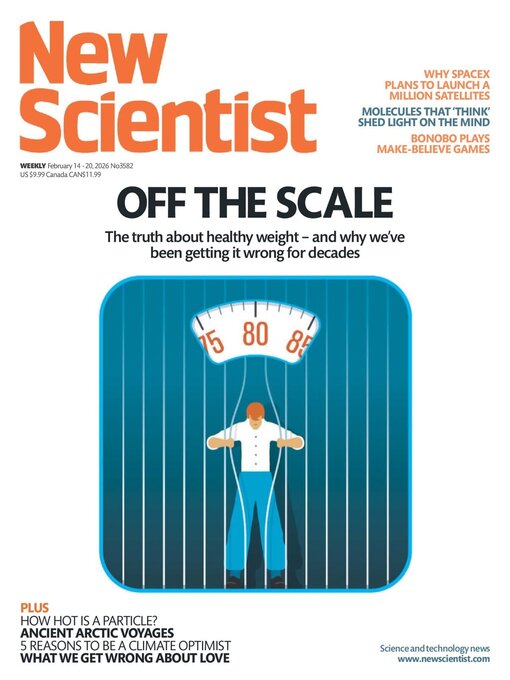
Why did SpaceX just apply to launch 1 million satellites? • Elon Musk’s proposal to deploy a huge number of data centres in orbit may not be entirely serious, finds Jonathan O’Callaghan
Tea party test shows the imaginative capabilities of bonobos
Dutch air force reads pilots’ brainwaves to toughen training
On the bright side • It is possible to be an environmental optimist despite it all, says Fred Pearce, who refuses to despair about the state of the world
The genetics column • Rolling the genetic dice Would you genetically enhance your future child if you could? Michael Le Page explores what might be possible – and whether it would be a good idea
Zooming in
Three other great books on relationships
The true path to love? • We are told we need cynical strategies to “play” the dating game, but the science says this is totally wrong. David Robson enjoys an evidence-based takedown
New Scientist recommends
The sci-fi column • Short but perfectly formed In George Saunders’s Vigil, a ghost visits a dying oil tycoon, while terraforming efforts on Mars are about to bear fruit in The Rainseekers by Matthew Kressel. Emily Wilson explores two very different short novels
Your letters
Escape the scales • BMI has long been used to determine someone’s health, but it is deeply flawed. Better measures of body fat exist – and they are finally catching on, finds Starre Vartan
Better ways to assess body fat
What makes a mind? • We are starting to teach molecules to “think” – and it is bringing us closer to working out what a mind really is, discovers Conor Feehly
“What does it mean to put a dollar value on...